Money is multiplayer: how Fragment powers collaboration with Liveblocks
Fragment is infrastructure for automating financial operations. See how they used Liveblocks Storage to make their schema editor multiplayer and fix their front end along the way.
21-50Founded 2021With Liveblocks since July 2025fragment.dev
Fragment is infrastructure for automating financial
operations. They work with fintechs, marketplaces, and brokered businesses where
money movement is core to the product and too complex for tools like Stripe. As
those products evolve from simple payments into wallets, credit, rewards, and
cross-border flows, teams need infrastructure that handles both scale and
complexity. Building the infrastructure was just the first part of the problem.
They also needed to figure out how to make it usable for cross-functional teams
who ship financial products.
Money is multiplayer. Multiple systems, teams, and perspectives are constantly
interacting with the same financial data, which makes building financial
products deeply cross-functional. Engineering, product, finance, compliance, and
operations all need to align on how money moves through a system.
Before Fragment, that work moved through a chain of disconnected tools: product
wrote a PRD, finance translated it into accounting scenarios in a spreadsheet,
and engineering implemented it in code. Because each team spoke a different
language and worked in different tools, every handoff introduced risk.
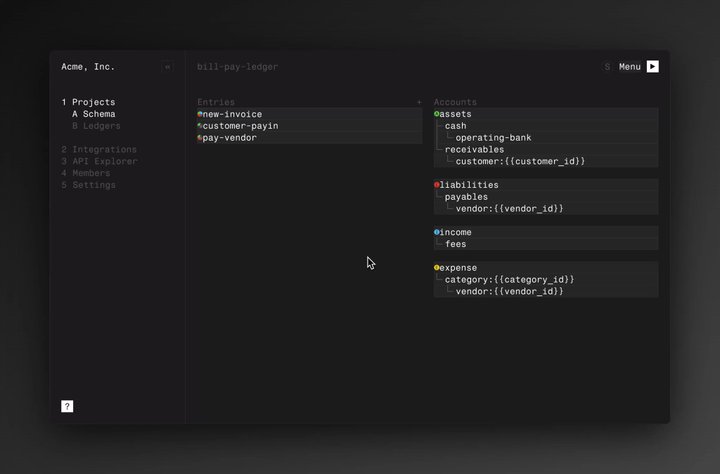
Fragment's answer is a low-code schema editor. Under the hood, it edits a
strongly-typed JSON config that defines how funds move through a customer's
product. On the surface, it's a UI that engineers, finance, and operations can
all work in together. It's the first thing customers see in a demo and the
fastest way for them to understand how Fragment works.
Inviting teammates, then watching the live avatar stack grow as people join the schema editor.
“What we built with Liveblocks is the first thing customers see when they demo the product. It's the most valuable part of the product.”
Fragment first shipped the schema editor as a local CLI tool, then brought it to
the web with a homegrown sync approach: an auto-polling save running every ten
seconds from each connected client. It didn't hold up. Two tabs in the same
browser would clobber each other. Viewers could overwrite the work of editors.
Customers would put hours of work into a schema, walk away, and come back to
find it gone. The Fragment team was spending real time digging through logs to
recover lost data.
The team briefly considered going back to single-player, but cross-functional
collaboration was the whole point of the editor. They committed to fixing the
multiplayer story properly. Building the realtime layer themselves wasn't a
serious option. Their team is focused on financial infrastructure, not realtime
sync. They evaluated Yjs and a handful of sync engine vendors before landing on
Liveblocks.
“It just works. The product is simple in a good way.”
Varun MohanCTO at Fragment
The migration was deliberately incremental. Fragment started with a single menu
in the editor as a proof of concept, rather than rewriting the whole experience
at once. That gave them a low-stakes way to validate the integration in their
stack before committing to the full migration.
Create, adjust, and reconcile billing workflows in Fragment's schema editor.
Today, Fragment uses Liveblocks
Storage
and
Presence.
All shared state on the core editing pages is managed by Liveblocks behind a
clean read and write boundary, so the rest of Fragment's app doesn't need to
know how realtime sync is implemented.
Integrating Liveblocks took longer than the team expected, and not because of
Liveblocks. To use it cleanly, the front end had to be coherent. Fragment's
existing front end had been written quickly during the early GPT-3 era, with a
tangle of React components, useEffects, and state management that more or less
worked but was hard to reason about. Liveblocks didn't fit until that was
untangled.
“Integrating with Liveblocks made our code better. We had a jangled mess of React components. It forced us to untangle the garbage, and now we can do more with tools like Claude.”
Varun MohanCTO at Fragment
The cleanup paid off in two ways. The first was reliability. With all shared
state living in Liveblocks behind a clear boundary, the entire class of
clobbering and lost-save bugs went away. The second was velocity. The cleaner
front end is now something Fragment's AI coding tools can actually contribute
to. Claude can take a feature from Fragment's API and add the corresponding UI
on its own. Designers who used to avoid the front end are shipping changes there
directly. We have also made it easier to build with Liveblocks in AI coding
tools—see our agent skills for Cursor and Claude.
The schema editor is now central to how customers use Fragment. Teams model
funds flows visually, work side by side across engineering, finance, and
operations, and align on the design before any of it ships to production. The
same JSON config can also be edited from Fragment's CLI or API and synced into
the editor through an async backing process, so engineers who prefer the
terminal aren't cut off from the multiplayer experience.
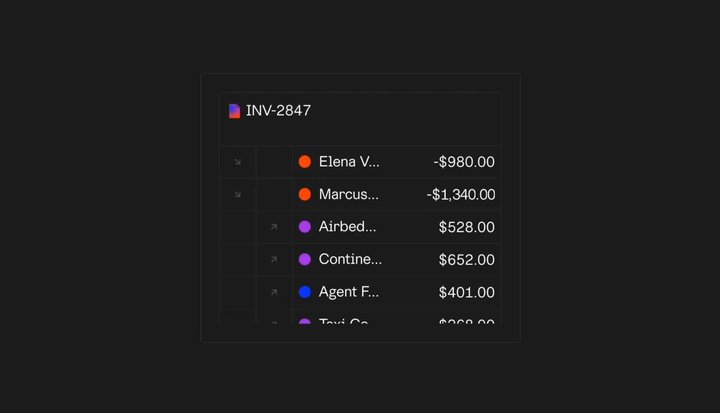
Teams model funds flows and edit the schema together in Fragment's multiplayer editor.
Instead of passing documents and spreadsheets between teams, the work happens in
one shared environment. The result is faster development, fewer accounting bugs,
and more confidence in how financial systems behave under load.
A few pieces of advice from Varun Mohan, CTO of Fragment, for teams thinking
about adding multiplayer to their own product:
Small edge cases become big problems in collaborative systems. Multiple tabs,
unsaved changes, and conflicting updates break user trust quickly, especially
when the underlying data is critical.
Be honest about what is and isn't your core competency. Building realtime
collaboration infrastructure is a real engineering investment. If it isn't
central to your product, it'll pull time away from what actually
differentiates you.
Talk through your architecture early. Reviewing the design with the
Liveblocks team can save time and prevent rework, even if you think you can
figure it out on your own.