Dashboard enhancements to improve observability and developer experience
Introducing new dashboard features including room state visualizations, custom event broadcasting, and improved user monitoring, elevating developer experience and observability.
Observability is essential for debugging and understanding user behavior in
collaborative applications, and the Liveblocks dashboard is
designed specifically for this purpose, forming a crucial part of our complete
collaboration infrastructure.
In recent months, we’ve made significant strides in enhancing our dashboard even
further, adding new features, improving developer experience, and enabling
faster debugging and development. We’re excited to share our progress.
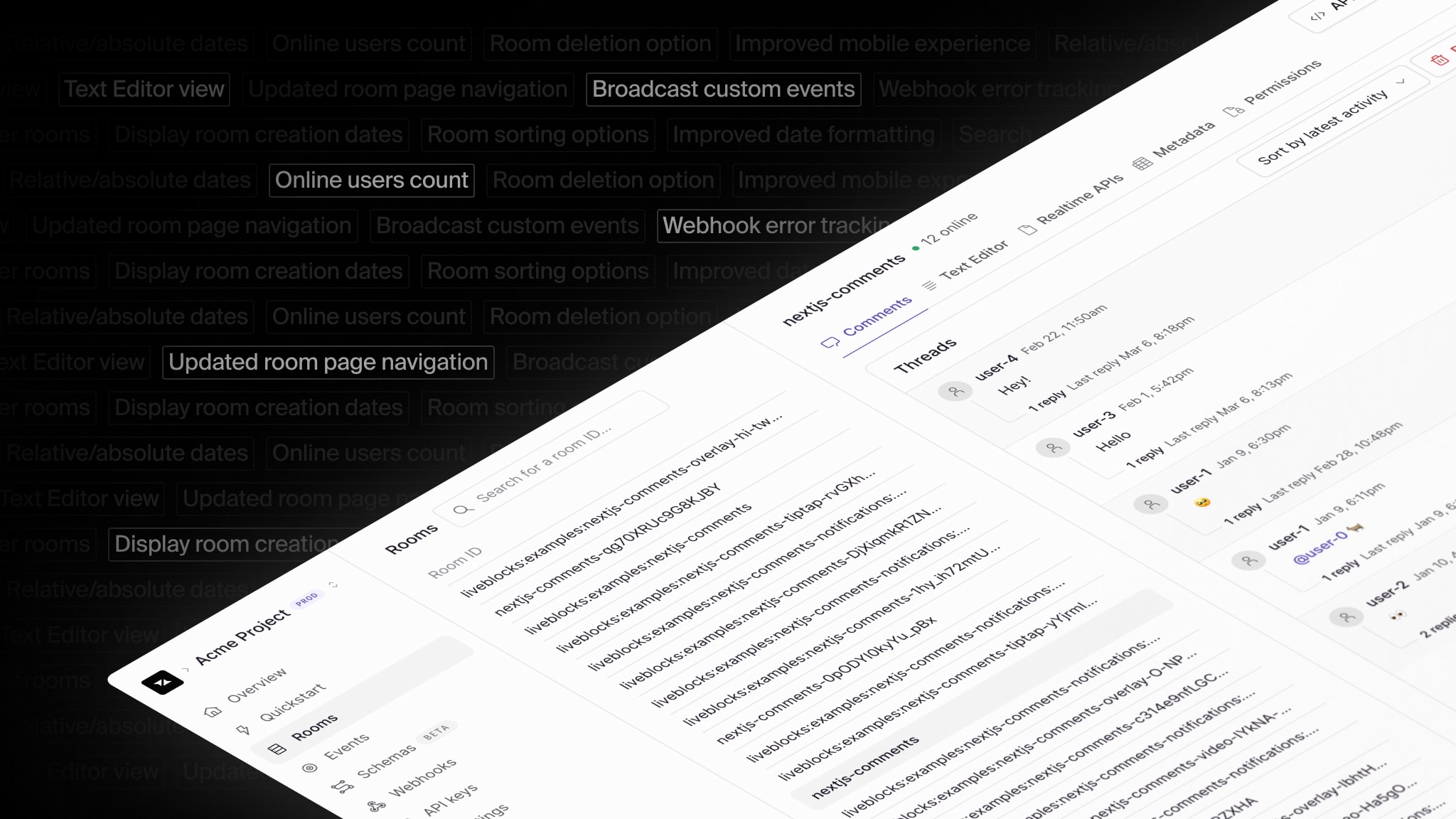
It’s now possible to debug your application more easily thanks to the new
filtering and sorting options in your project’s rooms listing page. This makes
it easier to find the exact room you’re looking for, whether you’re looking for
a particular room ID, last connection date, thread count, or more.
A small touch you may notice is that we’ve also improved dates across the
dashboard. Each date now shows more a human-readable format, and you can see the
exact time/timezone when you hover over each.
A number of improvements have been made to each room’s detail page in the
dashboard, for example you can delete rooms directly from the dashboard, saving
you time using our APIs, and see how many users are currently connected.
The tabs under each room have also been revamped to reflect our new product
offering launched in Liveblocks 2.0, and
include many new features, which we’ve detailed below.
When using Liveblocks Comments, each room’s thread can be viewed
directly from the dashboard with our new visual display. Along with being able
to view & sort your threads, replies, metadata, and reactions, you can also make
deletions directly from the UI.
If you’d prefer dive directly into the code, we’ve also retained the previous
JSON data views as an option, allowing to read implementation details such as
the comment body.
Each room using Liveblocks Text Editor also now features a
visual way to explore your documents from the dashboard. Because Comments deeply
integrates into Text Editor, we can display each annotation and thread that’s
attached to the document. The display even handles overlapping annotations for
you.
Text Editor relies on Lexical editor, and if you add a
custom component to the editor, it will be inlined into the preview, showing its
JSON state. We’ve also added a JSON view for the whole document, displaying
Lexical’s internal state, should you wish to debug more deeply.
You can now broadcast custom events directly from the dashboard, a feature that
is particularly helpful for testing
useEventListener in
your application.
Events are particularly helpful for notifying users to revalidate their data in
realtime, or to send toast messages to other users. Learn more in our
interactive tutorial page on
broadcasting events.
Should you wish to quickly fetch or modify your room, you can now press the
“API” button to find cURL and Node.js snippets in the rom detail page. Each
snippet is pre-filled with the correct secret key and room ID, meaning you can
paste them directly into your terminal or code.
We’ve added a new way to debug webhooks—if a webhook were to fail for any
reason, you can now check the response returned from your application. This
makes it easier to diagnose problems caused by your back end not responding
correctly.
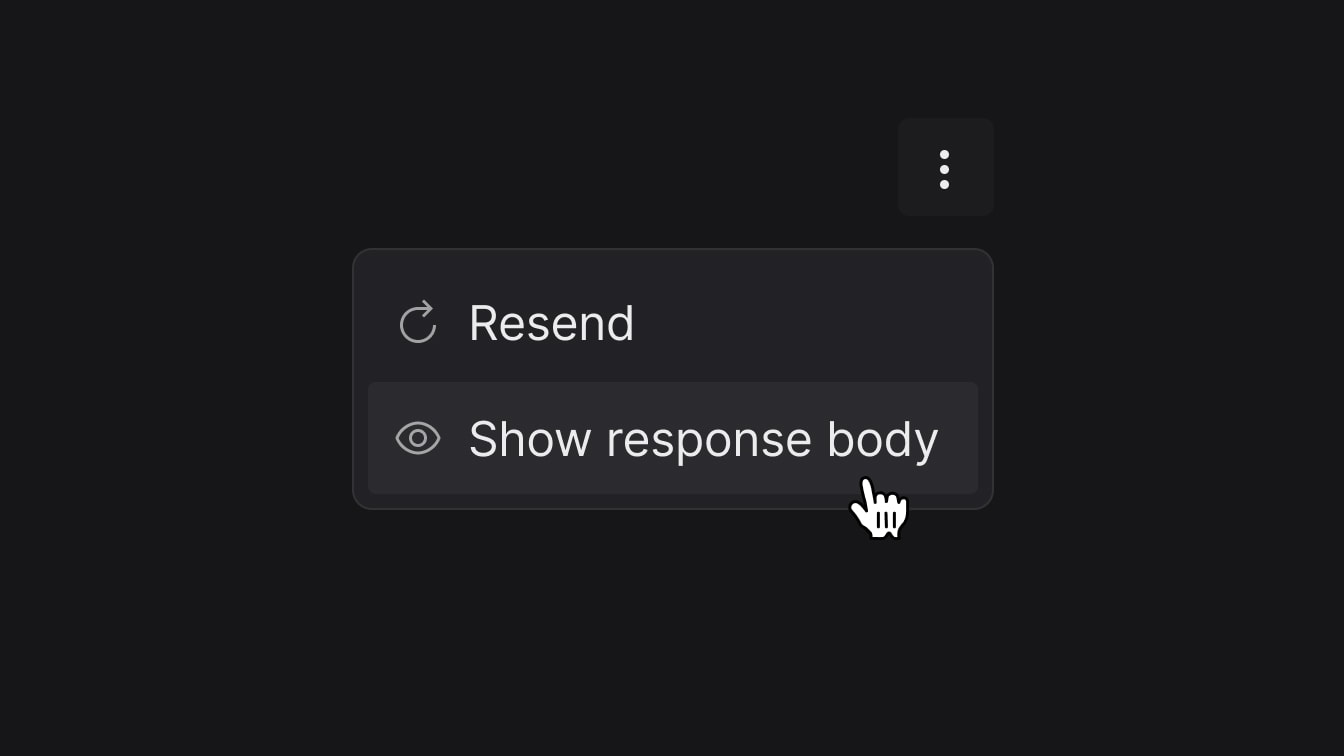
To find the new feature, open a webhook event in the dashboard, click a dropdown
under the “Webhook events” section, and look for “Show response body”.