• DocsDocs
  • PricingPricing
Sign in
Get started
Sign in
Get started
    • Realtime Infrastructure
      • Presence
        Presence

        Online users, cursors, selections

      • Broadcast
        Broadcast

        Temporary event signals

      • Storage
        Storage

        Synced conflict-free data

      • Feeds
        FeedsBeta

        Messages and activity logs

      • Threads
        Threads

        Contextual conversations

    • Collaboration features
      • Multiplayer
        Multiplayer

        Realtime collaboration

      • Comments
        Comments

        Contextual commenting

      • Notifications
        Notifications

        Smart alerts for your app

      • AI Copilots
        AI Copilots

        Individual AI assistants

    • Tools
      • Examples

        Gallery of open source examples

      • Showcase

        Gallery of collaborative experiences

      • Next.js Starter Kit

        Kickstart your Next.js collaborative app

      • DevTools

        Browser extension

      • Tutorial

        Step-by-step interactive tutorial

      • Guides

        How-to guides and tutorial

      • Figma UI Kit

        Liveblocks Collaboration Kit

    • Company
      • Blog

        The latest from Liveblocks

      • Customers

        The teams Liveblocks empowers

      • Changelog

        Weekly product updates

      • Security

        Our approach to security

      • About

        The story and team behind Liveblocks

  • Docs
  • Pricing
  • Realtime Infrastructure
    • Presence
    • Broadcast
    • Storage
    • FeedsBeta
    • Threads
    Collaborative features
    • Multiplayer
    • Comments
    • Notifications
    • AI Copilots
    Solutions
    • People platforms
    • Sales tools
    • Startups
    Use cases
    • Multiplayer forms
    • Multiplayer text editor
    • Multiplayer creative tools
    • Multiplayer whiteboard
    • Comments
    • Sharing and permissions
    • Document browsing
  • Resources
    • Documentation
    • Examples
    • Showcase
    • DevTools
    • React components
    • Next.js Starter Kit
    • Tutorial
    • Guides
    • Release notes
    Technologies
    • Next.js
    • React
    • JavaScript
    • Redux
    • Zustand
    • Yjs
    • Tiptap
    • BlockNote
    • Slate
    • Lexical
    • Quill
    • Monaco
    • CodeMirror
  • Company
    • Pricing
    • Blog
    • Customers
    • Changelog
    • About
    • Contact us
    • Careers
    • Terms of service
    • Privacy policy
    • DPA
    • Security
    • Trust center
    • Subprocessors
  • HomepageSystem status
    • Github
    • Discord
    • X
    • LinkedIn
    • YouTube
    © 2026 Liveblocks Inc.
Blog/Updates

Introducing the brand new Liveblocks docs

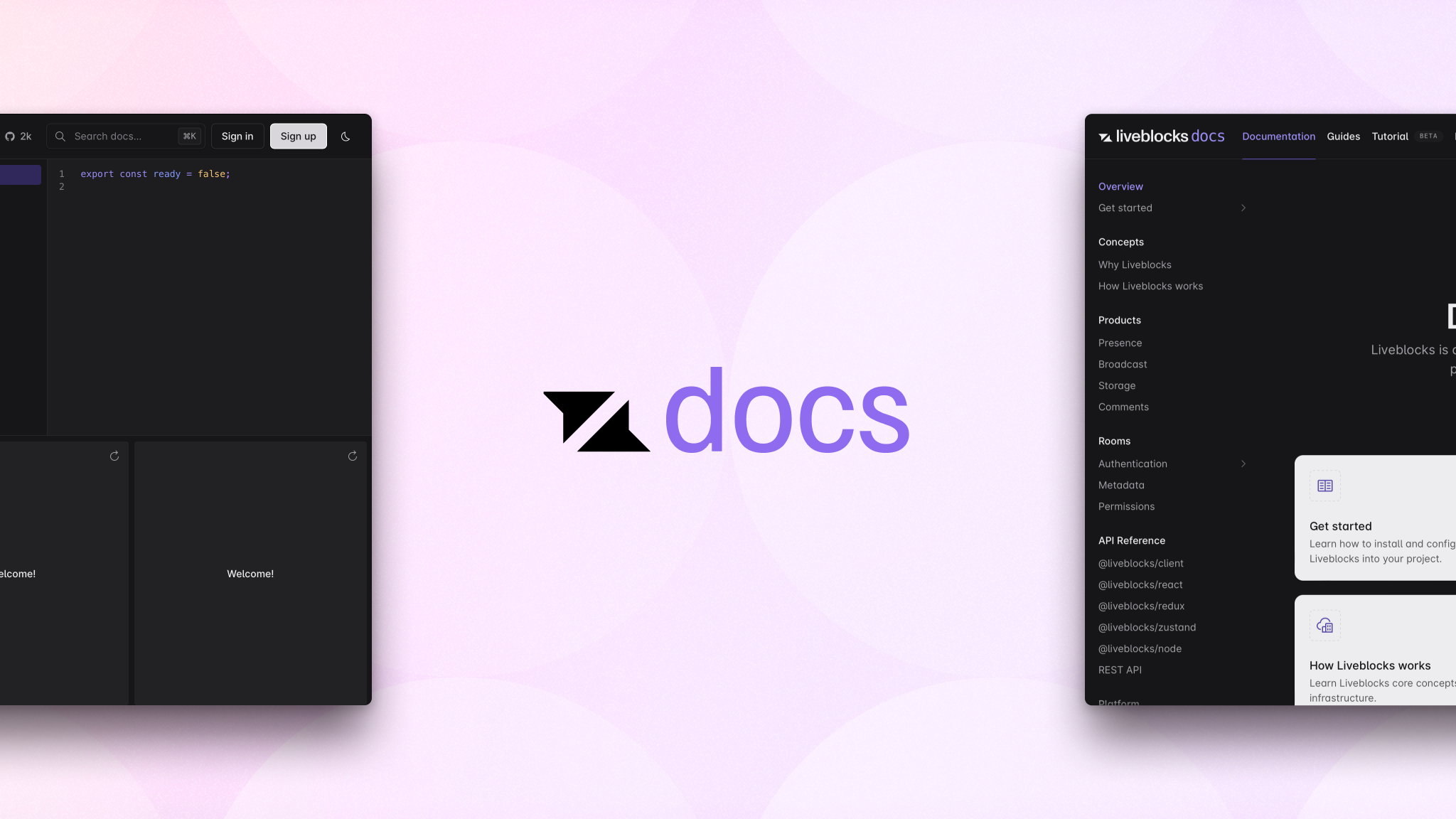
Today, we're thrilled to introduce the brand new Liveblocks docs which includes new how-to guides and content, quickstart instructions, an interactive tutorial, ⌘K search, and more!

on June 27th, 2023
Introducing the brand new Liveblocks docs
June 27th, 2023·3 min read
Share article
Product updates

Ready to get started?

Join thousands of companies using Liveblocks to build multiplayer experiences for people and agents.

Get started for free

Related blog posts

  • Agent skills for Liveblocks

    Agent skills for Liveblocks

    Picture of Chris Nicholas
    April 10th
    Updates
  • Python SDK for Liveblocks

    Python SDK for Liveblocks

    Picture of Chris Nicholas
    April 9th
    Updates
  • Chat SDK adapter for Liveblocks

    Chat SDK adapter for Liveblocks

    Picture of Chris Nicholas
    April 8th
    Updates

It’s fair to say that providing a great developer experience is close to our heart at Liveblocks. Documentation plays an essential part in that, so we’ve decided to treat documentation as its own standalone product. From day one, the docs was built as a custom solution to give us the flexibility and control we needed to provide the world-class developer experience we always aimed for. This approach is now starting to pay dividends.

Today, we’re thrilled to introduce the brand new Liveblocks docs which includes new how-to guides and content, quickstart instructions, an interactive tutorial, ⌘K search, and more!

Interactive tutorial

There are many ways to learn new technology. And for some people, following a step-by-step tutorial is the preferred way. That’s why we’ve built a brand new interactive tutorial section in the docs where you can learn Liveblocks concepts without having to set up a collection of tools on your machine.

The interactive tutorial is currently in beta, and we’ll be adding new content and improving it as the community shares feedback with us.

New how-to guides and content

We’ve introduced a new guides section where you’ll find detailed how-to guides for specific use cases and technologies. You can find guides by using the search or through the filters.

We’ve also written dedicated concepts pages with illustration to explain why Liveblocks exists and how it all works.

Quickstart instructions

As part of the new docs, we wanted to make it as easy as possible to get started. To do so, we’ve removed our previous lengthy get started pages in favor of new step-by-step quickstart instructions.

You’ll find instructional pages for Next.js, React, Svelte, Vue.js, SolidJS, JavaScript, Zustand, and Redux.

⌘K search

From anywhere in the docs, you can start searching by hitting ⌘K (or Ctrl+K on Windows). The search dialog also references how-to guides, API Reference, and all documentation pages.

Designed to work on any device

The new documentation was designed to work on any device and browser window to keep you in flow. If you’d like to read our docs or try our interactive tutorial while you’re on the go, you can. If you’d prefer to read a guide alongside your code editor window, you can do that too!

Contributions

As part of this project, we’ve made it even easier to contribute through feedback and content. To share feedback with the developer experience team, hit the 👍 or 👎 buttons at the bottom of any given page in the docs.

If you wish to contribute to the docs, feel free to hit the "Edit this page" button or directly submit a pull request on the open-source repository.