Chat SDK bot (Advanced)
This example shows how to build a Chat SDK bot with Liveblocks and Next.js.
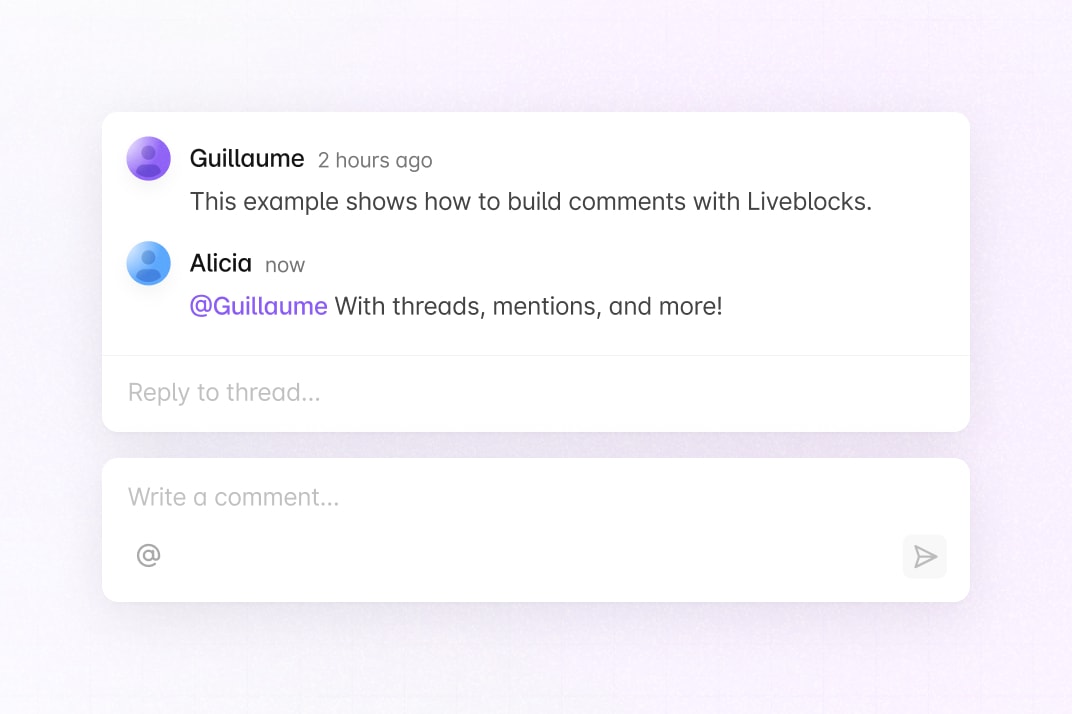
When someone @-mentions the bot in a thread, it replies in the thread; adding a reaction to a message triggers a short reply as well.
Getting started
Run the following command to try this example locally:
This will download the example and ask permission to open your browser, enabling you to automatically get your API key from your liveblocks.io account.
Setting up webhooks
The Liveblocks adapter (@liveblocks/chat-sdk-adapter) needs Liveblocks
webhooks to receive new comments and reactions.
- Follow our guide on testing webhooks locally. When creating the webhook endpoint, enable the commentCreated, commentReactionAdded, and commentReactionRemoved events (see webhook events)
- Copy your webhook secret (
whsec_…) from the webhooks dashboard - Add it to
.env.localas theLIVEBLOCKS_WEBHOOK_SECRETenvironment variable
Manual setup
Alternatively, you can set up your project manually:
- Install all dependencies with
npm install - Create an account on liveblocks.io
- Copy your secret key from the dashboard
- Create an
.env.localfile and add your secret key as theLIVEBLOCKS_SECRET_KEYenvironment variable - Run
npm run devand go to http://localhost:3000 - Follow the “Setting up webhooks” section above
Deploy on Vercel
To both deploy on Vercel, and run the example locally, use the following command:
This will download the example and ask permission to open your browser, enabling you to deploy to Vercel.
Next, follow the “Setting up webhooks” section above (use your production webhook URL).
Develop on CodeSandbox
After forking
this example
on CodeSandbox, add the LIVEBLOCKS_SECRET_KEY and LIVEBLOCKS_WEBHOOK_SECRET
environment variables as secrets.
Webhook delivery to a sandbox URL may require a tunnel (see testing webhooks locally).